Complete Instructor Training
  • Home
    • Meet Your Trainer
    • Part 1 Test
    • Part 2 Test
    • Part 3 Test
  • Members
    • Mentoring Session - AMJ
    • Standard Check Success Videos
    • Standard Check Success 01.08.22
    • 01 Lesson Planning
    • 02 Risk Management
    • 03 Teaching and Learning Strategies
    • Client Centred
  • FAQ's
  • Blog
  • Contact
  • Home
    • Meet Your Trainer
    • Part 1 Test
    • Part 2 Test
    • Part 3 Test
  • Members
    • Mentoring Session - AMJ
    • Standard Check Success Videos
    • Standard Check Success 01.08.22
    • 01 Lesson Planning
    • 02 Risk Management
    • 03 Teaching and Learning Strategies
    • Client Centred
  • FAQ's
  • Blog
  • Contact
Picture


Introduction

Click the buttons below to download:

The National Standards
National Car Syllabus
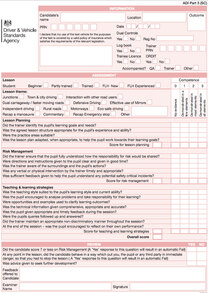
STANDARDS CHECK MARKING SHEET
ADI Pt3 Marking Sheet

Video Training Sessions

The following videos take you through each of the 17 different skills competences you will need to develop and maintain as a fully qualified Driving Instructor. They are the same competencies marked on both the Part 3 Marking Sheet and the Standards Check SC1 forms. These competencies are marked by the examiner when you take your Part 3 Instructor Ability Test and then thereafter when you take a regular Standards Check.
Picture
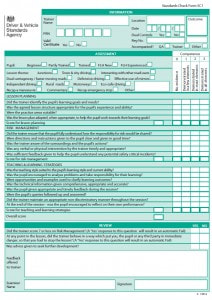
Standards Check (SC1) Marking Sheet
Picture

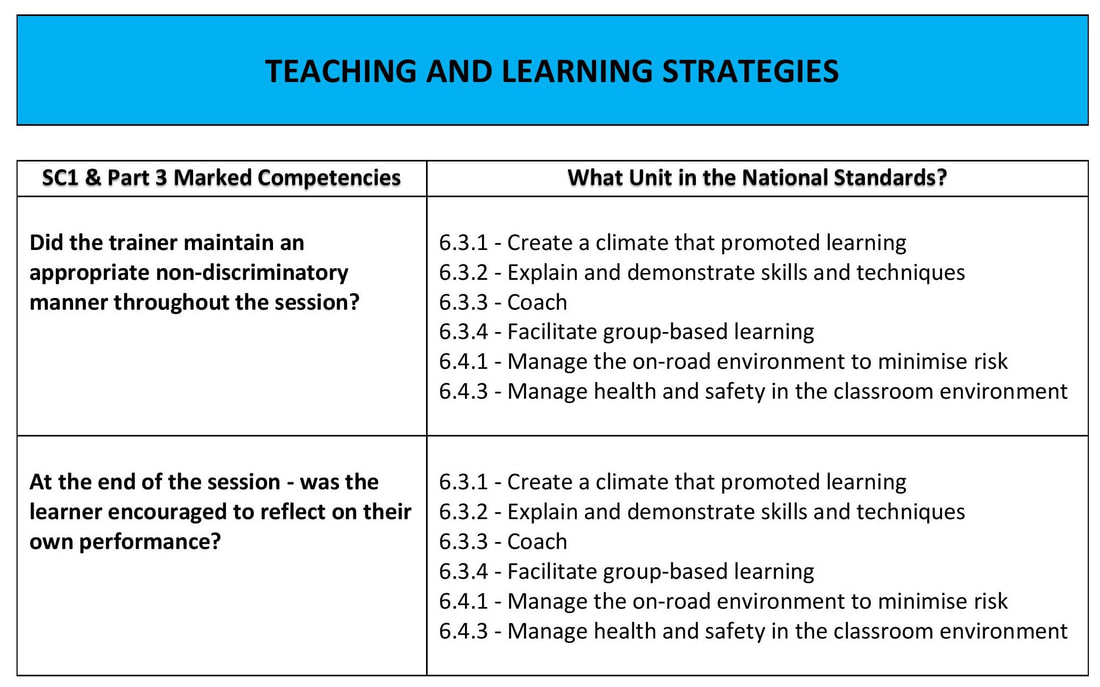
Where the Competencies apply to the National Standards

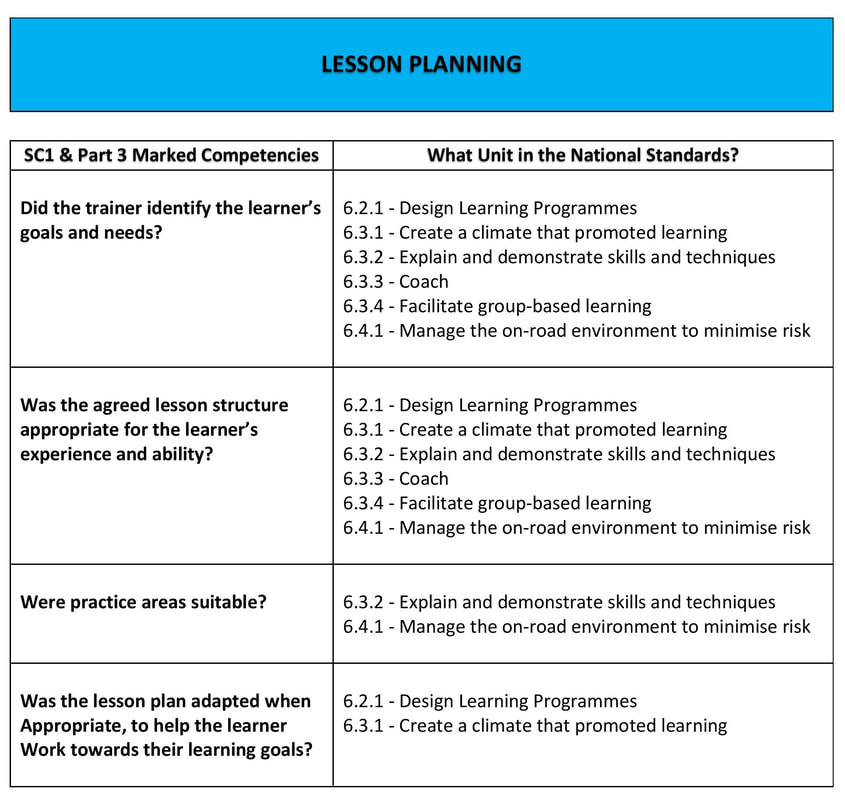
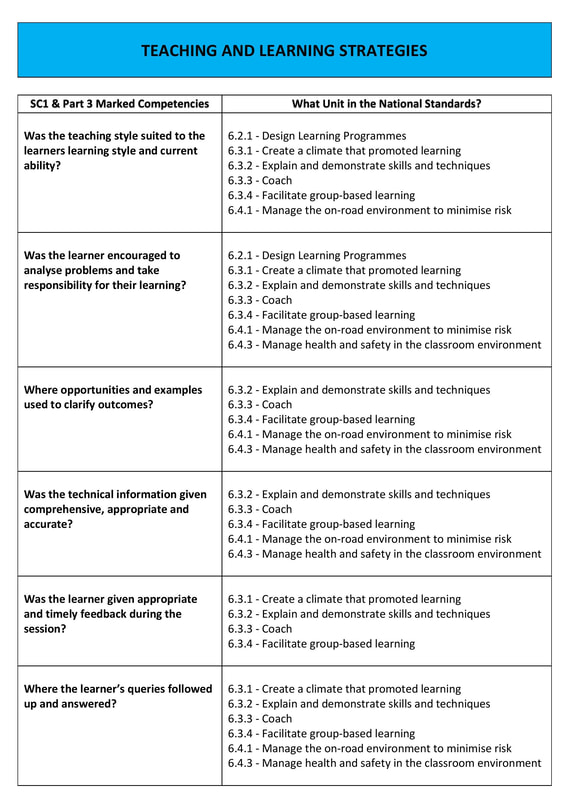
In the 'Cross Reference' table below each of the different sections, Lesson Planning, Risk Management and Teaching and Learning Strategies you will see how they have been linked and cross referenced to each of the 17 different competencies of the Part 3 test marking sheet and the Standards Check marking form (SC1) and the National and Driver and Rider Standard.

You will see from the relevant section in the Standards where you might need to develop as a trainer, what you need to be able to do and what you need to know and understand.

​You can download and print out the full cross reference table by clicking here.

Continuous Personal Development

Your continuous personal development as a trainer should be ongoing around delivering a great client-centred driving lesson in accordance with these standards.

Remember why you are undertaking training? Training should be a continuous process of improvement and development. You are teaching your pupil's to drive safely for life and not pass a driving test. Therefore, you should not be preparing for a Standards Check. When you deliver training, the standard of that training should follow the national standards every session. Your training should reflect the National Standards and how you are performing around each of the competences you are being assessed against.  The Standards Check that all ADI's take roughly every 4 years is there to ensure you are continuing to teach to a high standards every lesson and not just for the Standards Check.

You can download and print out the full cross reference table by clicking here.

Lesson Planning

Cross-Reference Table

Picture
You can download and print out the full cross reference table by clicking the button below:
Cross Reference Table
Download the National Standards by clicking the button below:
The National Standards

Competence No.1

Did the trainer identify the pupil's learning goals and needs?

For a summary of 'Must' and 'Must Not's' click the buttons below.

what you MUST DO
  • Set Goals by encouraging your pupil to say what they want from the lesson
  • Ask questions to ensure understanding
  • Check understanding as the lesson progresses
  • Listening to what your pupil is saying
  • Take note of body language
what you must not do
  • Make assumptions about understanding or experience
  • Fail to note negative or concerned comments or body language that shows discomfort
  • Undermine your pupil’s confidence by continually asking questions clearly beyond their knowledge or understanding
  • Push your pupil to address issues that they are not happy to talk about, unless there is a clear need, such as an identified risk or a safety critical issue

Click the Button below to download a transcript of this video:
VIDEO TRANSCRIPT

Goal Setting

This video takes you though Goal setting with your pupil. I talk about using the G.R.O.W. model to help you do that and making Goals S.M.A.R.T.  I give you examples of questions you can use and an example of a coaching conversation using the G.R.O.W. to set a Goal for the lesson at the beginning of a training session. 

Body Language

Over 50% of how we communicate a message is through our body language. This video talks about body language and the messages it can give out.

Competence No.2

​Was the agreed lesson structure appropriate for the pupil's experience and ability?

For a summary of 'Must' and 'Must Not's' click the buttons below.

what you MUST DO
  • Ensure the pupil understands what they plan to do and agrees with that plan.
  • Structure a lesson that reflects the information given by the pupil and the learning goals they want to tackle.
  • Build in opportunities to check the statements made by the pupil before moving to more challenging situations.
  • Ensure you are checking theoretical understanding.
what you must not do
  • Deliver a pre-planned, standard lesson that doesn’t take into account the pupil’s expressed needs or concerns.
  • Fail to build in a suitable balance of practice and theory into your lesson.

Click the button below to download a transcript of this video:

VIDEO TRANSCRIPT

Competence No.3

Where practice areas suitable?

For a summary of 'Must' and 'Must Not's' click the buttons below.

what you MUST DO
  • Have a route or practice area that has a range of opportunities to address the agreed learning objectives.
  • Ensure the practice area challenges, but is realistic in terms of the pupil’s capabilities and confidence. 
what you must not do
  • The practice area you choose takes the pupil outside of their competence zone so that they spend all their time ‘surviving’ and have no space left to look at learning issues.
  • Expose the pupil to risks they cannot manage​.

Click the button below to download a transcript of this video:

VIDEO TRANSCRIPT

Competence No.4

Was the lesson plan adapted, when appropriate, to help the pupil work towards their learning goals?

For a summary of 'Must' and 'Must Not's' click the buttons below.

what you MUST DO
  • Compare the actual performance of the pupil with their claims and clarifying any differences.
  • Respond to any faults or weaknesses that undermine the original plan for the session.
  • Respond to any concerns or issues raised by the pupil.
  • Pick up on non-verbal signs of discomfort or confusion.
​
what you must not do
  • Persist with a plan despite the pupil being clearly out of their depth.
  • Persist with a plan despite the pupil demonstrating faults or weaknesses that should lead to a rethink of the plan. 
  • Change the plan without reason.
  • Failing to explain to the pupil why the plan has been changed.
​

Click the button below to download a transcript of this video:

VIDEO TRANSCRIPT

Risk Management

Picture
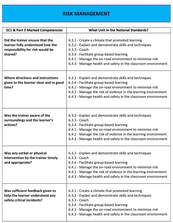
You can download and print out the full cross reference table by clicking here.

RISK MANAGEMENT

Introduction

Click the button below to download a transcript of this video:

VIDEO TRANSCRIPT

Competence No.1

Did the trainer ensure the pupil fully understood how the responsibility for risk would be shared?

For a summary of 'Must' and 'Must Not's' click the buttons below.

what you MUST DO
  • Ask the pupil what is meant by risk.
  • Ask the pupil what sorts of issues create risk, such as the use of alcohol or drugs.
  • Explain clearly what is expected of the pupil and what the pupil can reasonably expect of the ADI/PDI
  • Check that the pupil understands what is required of them when there is a change of plan or they are asked to repeat an exercise. 
​
what you must not do
  • Fail to address the issue of risk management.
  • Give incorrect guidance about where responsibility lies for management of risk.
  • Fail to explain how dual controls will be used.
  • Undermine the pupil’s commitment to being safe and responsible, e.g. by agreeing with risky attitudes to alcohol use.
  • Ask the pupil to repeat a manoeuvre or carry out a particular exercise without making sure that they understand what role you are going to play. 
​

Click the button below to download a transcript of this video:

VIDEO TRANSCRIPT

Competence No.2

Were directions and instructions given to the pupil clear and given in good time?

For a summary of 'Must' and 'Must Not's' click the buttons below.

what you MUST DO
  • Give clear, concise directions
  • Ensure the pupil understands what they plan to do and agrees with that plan.
  • Give directions at a suitable time so that the pupil can respond.
​
what you must not do
  • Give confused directions.
  • Give directions too late.
  • Give unnecessary directions.
  • failing to recognise when your input is causing overload or confusion.
​

Click the button below to download a transcript of this video:

VIDEO TRANSCRIPT

Competence No.3

Was the trainer aware of the surroundings and the pupils actions?

For a summary of 'Must' and 'Must Not's' click the buttons below.

what you MUST DO
  • ​Take in the outside world
  • Observe the actions of the pupil, including comments and body language.
  • Judge whether those actions are suitable in any given situation.
  • Respond accordingly.
​
what you must not do
​Any serious lapses in this area are likely to lead to a 0 marking.​

Click the button below to download a transcript of this video:

VIDEO TRANSCRIPT

Competence No.4

Was any verbal or physical intervention timely and appropriate?

For a summary of 'Must' and 'Must Not's' click the buttons below.

what you MUST DO
  • Intervene in a way that actively supports the pupil’s learning process and safety during the session.
  • Allow the pupil to deal with situations appropriately
  • Take control of situation where the pupil is clearly out of their depth.
​
what you must not do
  • Ignore a developing situation and leaving the pupil to flounder.
  • Take control of a situation the pupil is clearly dealing with appropriately.
  • Constantly intervening when unnecessary.
  • Intervene inappropriately and creating distractions.
  • Undermining the pupil’s confidence.
  • Reinforce the you as the person who is in sole control of the lesson.
​

Click the button below to download a transcript of this video:

VIDEO TRANSCRIPT

Competence No.5

Was sufficient feedback given to help the pupil understand any potential safety critical incidents?

For a summary of 'Must' and 'Must Not's' click the buttons below.

what you MUST DO
  • Find a safe place to stop and examine the critical incident.
  • Allow the pupil time to express any fears or concerns the incident might have caused.
  • Support the pupil to reflect clearly about what happened.
  • Provide input to clarify aspects of the incident that the pupil does not understand.
  • Support the pupil to identify strategies for future situations.
  • Provide input where the pupil does not understand what they should do differently.
  • Check that the pupil feels able to put the strategy in place.
  • Agree ways of developing that competence if the pupil feels the need.
​
what you must not do
  • Fail to examine the incident.
  • Take too long to address issues generated by an incident.
  • Allow the pupil to explore their own understanding.
  • Tell the pupil what the solution is and not checking their understanding.
  • Fail to check the pupil’s ability to put in place the agreed strategy.
​

Click the button below to download a transcript of this video:

VIDEO TRANSCRIPT

Teaching and Learning Strategies

Picture
You can download and print out the full cross reference table by clicking here.

Competence No.1

Was the teaching and learning style suited for the pupil's level of ability?

For a summary of 'Must' and 'Must Not's' click the buttons below.

what you MUST DO
  • Actively work to understand how you can best support the pupil’s learning process (you might not achieve a full understanding in the session – it is the attempt that demonstrates competence)
  • Modify teaching style when or if you realise there is a need to do so.
  • Provide accurate and technically correct demonstration, instruction or information - giving technically incorrect instruction or information is an automatic fail if that input might lead to a safety critical situation.
  • Use practical examples and other similar tools to provide different ways of looking at a particular subject.
  • Link learning in theory to learning in practice
  • Encourage and help the pupil to take ownership of the learning process.
  • Respond to faults in a timely manner.
  • Provide enough uninterrupted time to practice new skills.
  • Provide the pupil with clear guidance about how they might practice outside the session. 
​
what you must not do
  • ​Adopt a teaching style clearly at odds with the pupil’s learning style.
  • Fail to check with the pupil whether the approach they are taking is acceptable.
  • Fail to explore other ways of addressing a particular learning point.
  • Concentrate on delivering teaching tools rather than looking for learning outcomes.
  • Ignoring safety issues.

Click the button below to download a transcript of this video:

VIDEO TRANSCRIPT

Competence No.2

Was the pupil encouraged to analyse problems and take responsibility for their learning?

For a summary of 'Must' and 'Must Not's' click the buttons below.

what you MUST DO
  • Provide time, in a suitable location, to explore any problems or issues that arose during the lesson or that were raised by the pupil.
  • Provide timely opportunities for analysis; promptly in the case of risk critical incidents.
  • Take time and using suitable techniques to understand any problems the pupil had with understanding an issue. 
  • Suggest suitable strategies to help the pupil develop their understanding, such as using practical examples or pointing them at further reading.
  • Give clear and accurate information to fill gaps in the pupil’s knowledge or understanding.
  • Leave the pupil feeling that they have responsibility for their learning in the situation.
​
what you must not do
  • ​Leave the pupil feeling that the ADI was in control of the teaching process.
  • Fail to explore alternative ways of addressing a problem – in response to evidence of different learning preferences.
  • Provide unsuitable or incorrect inputs. 
​

Click the button below to download a transcript of this video:

VIDEO TRANSCRIPT

Competence No.3

Were opportunities and examples used to clarify learning outcomes?

For a summary of 'Must' and 'Must Not's' click the buttons below.

what you MUST DO
  • Use examples identified on a lesson in a suitable way and at a suitable time to confirm or reinforce understanding.
  • Exploring different ways to use examples to respond to differences in preferred learning style.
  • Use examples that are within the pupil’s range of experience and ability to understand.
  • Recognise that some pupils will be able to respond instantly while others will want to think about the issue.
​
what you must not do
  • ​Use examples the pupil cannot really understand through lack of experience.
  • Use complex examples that the pupil doesn’t have the ability to respond to.
  • Fail to give the pupil time to think through the issues and come to their own conclusion.
  • Impose an interpretation. 
​

Click the button below to download a transcript of this video:

VIDEO TRANSCRIPT

Competence No.4

Was the technical information given comprehensive, appropriate and accurate?

For a summary of 'Must' and 'Must Not's' click the buttons below.

what you MUST DO
  • ​Give clear, timely and technically accurate demonstrations or explanations.
  • Check understanding and, if necessary, repeating the demonstration or explanation.
  • Find a different way to demonstrate or explain if the pupil still does not understand.
what you must not do
  • Provide inaccurate or unclear information, too late or too early in the learning process.
  • Fail to check understanding.
  • Fail to explore alternative ways of presenting information where the pupil does not understand the first offering.
​

Click the button below to download a transcript of this video:

VIDEO TRANSCRIPT

Competence No.5

Was the pupil given appropriate and timely feedback during the session?

For a summary of 'Must' and 'Must Not's' click the buttons below.

what you MUST DO
  • ​​Provide feedback in response to questions from the pupil.
  • Seek appropriate opportunities to provide feedback that reinforces understanding or confirms achievement of learning objectives.
  • Provide feedback about failure to achieve learning objectives that helps the pupil achieve an understanding of what they need to do to improve.
  • Provide feedback that the pupil can understand.
  • Provide consistent feedback that is reinforced by body language.
what you must not do
  • Provide feedback a long time after an incident so that the pupil cannot link the feedback to what happened.
  • Provide feedback that overlooks a safety critical incident.
  • Continuously Provide feedback when this may be distracting the pupil.
  • Fail to check the pupil’s understanding of feedback.
  • Provide feedback that is irrelevant to the pupil’s learning objectives, for example commenting on their personal appearance.
  • Refuse  to hear reasonable feedback about the ADI’s own performance.

Click the button below to download a transcript of this video:

VIDEO TRANSCRIPT

Competence No.6

Were the pupil's queries followed up and answered?

For a summary of 'Must' and 'Must Not's' click the buttons below.

what you MUST DO
  • Create a learning environment that encourages the pupil to ask questions throughout the lesson.
  • Respond openly, readily and appropriately to queries.
  • Provide answers of sufficient content or directing the pupil to suitable sources of information.
  • Actively confirming with pupils if their comments or body language suggest they may have a question.
  • Encourage the pupil to explore possible solutions for themselves. 
​
what you must not do
  • Make no effort to encourage the pupil to ask questions.
  • Refuse to respond to queries.
  • Provide inaccurate or incomplete information in response to queries.
  • Avoid the question ask or deny responsibility for answering it.
​

Click the button below to download a transcript of this video:

VIDEO TRANSCRIPT

Picture
You can download and print out the full cross reference table by clicking here.

Competence No.7

Did the trainer maintain an appropriate non-discriminatory manor throughout the session?​​​

For a summary of 'Must' and 'Must Not's' click the buttons below.

what you MUST DO
  • Keep a respectful distance and not invading the pupil’s personal space.
  • Ask the pupil how they wish to be addressed.
  • Ask a disabled driver to explain what the ADI needs to know about their condition.
  • Adopt an appropriate position in the car.
  • Use language about other road users that is not derogatory and that does not invite the pupil to collude with any discriminatory attitude.
​
what you must not do
  • Invade somebody’s physical space.
  • Touch the pupil, including trying to shake hands, unless it is necessary for safety reasons.
  • Use somebody’s first name unless they have said that this is acceptable.
  • Comment on the pupil’s appearance or any other personal attribute unless it has a direct impact on their ability to drive safely, such as wearing shoes that make it difficult for them to operate the vehicle’s pedals.
​

Click the button below to download a transcript of this video:

VIDEO TRANSCRIPT

Competence No.8

At the end of the session was the pupil encouraged to reflect on their own performance?​​​

For a summary of 'Must' and 'Must Not's' click the buttons below.

what you MUST DO
​​
  • At the end of the session the pupil should be encouraged to reflect on their performance 
  • and discuss their feelings with the ADI.
  • Encourage honest self-appraisal by the pupil.
  • Use client-centred techniques to highlight areas that need development.
  • Help the pupil identify development areas and encouraged the pupil to make them part of future development.
what you must not do
  • Make any attempt to encouraged the pupil to reflect on their own performance.
​

Click the button below to download a transcript of this video:

VIDEO TRANSCRIPT

Review

Review: Risk management​​​

Click the button below to download a transcript of this video:

VIDEO TRANSCRIPT

Video No.19


Video 19


​​

Video No.20


Video 20


​​

Video No.21


Video 21


​​

Video No.22


Video 22


​​

Video No.23


Video 23


​​

Video No.24


Video 24

​

​​

Copyright Instructor Training 2021